
How to Search Orange County Criminal Records
The Superior Court splits criminal case data by portal rather than offering one global search. The criminal and traffic site at visionpublic.occourts.org is the right starting point for misdemeanor, felony, and infraction case events. The portal opens with a terms screen. The court says clearly that the online data is a public service and is not the official court record. If a case number is not known, the Case Name Search at namesearch.occourts.org runs a person or business name lookup across case types.
A search by case number needs the full public case number. A partial number will not match. The portal can show case events, charges, pleas, hearings, and disposition lines. Traffic citations can take up to 21 days from issuance before they appear. Felony case data is kept for at least 75 years under Government Code section 68152. General misdemeanor data is kept for at least 5 years. Older paper files may sit at the right courthouse records unit.
- Open visionpublic.occourts.org and accept the criminal and traffic portal terms.
- Pick case number search if the full Superior Court case number is known.
- Use the Case Name Search if only a name is known.
- Complete the CAPTCHA or passline field when the portal asks.
- Open the case header and review the charges, hearings, and disposition.
- For custody status, switch to ocsheriff.gov and use the Inmate Information System.
- For a certified copy, contact the Superior Court records unit at the courthouse listed for the case.
Cross-reference is the smart move. The court record and the jail roster track different things, and a name match in one system is not always the same person in the other. Use date of birth, case number, and booking number to be sure.
Arrest Records vs Court Records
An arrest record and a court record are not the same file. An arrest is a law enforcement event. A police agency books a person, sets a booking number, and adds the person to a custody system. In Orange County that custody system is the OC Sheriff Inmate Information System. The arrest data shows the booking date, the holding facility, the charges presented at booking, and the bail amount. It does not say whether the case will end in a conviction. It does not say whether charges will be filed at all.
The court record begins later. After review, the District Attorney decides whether to file a formal charge. If filed, the case gets a public Superior Court case number and goes onto a calendar at the right justice center. From that point the court record carries the case events, hearings, pleas, motions, and the final disposition. The court record is the legal track. The arrest record is the custody track. A person can have an arrest with no court case if charges were never filed or were rejected by the DA.
Note: an arrest with no filed case may still appear in law enforcement databases and may need a separate sealing petition under Penal Code section 851.91 to restrict public access.
Charges vs Convictions in Orange County
The single most common misread of a criminal record is treating a charge as a conviction. A charge is what the prosecutor says happened. A conviction is what the court has ruled, or what the defendant has admitted by plea. Many cases end in something other than a conviction. Some are dismissed. Some end in a reduction to a lesser offense. Some end with diversion or treatment. The case file shows the path from start to end. Read the disposition line before drawing any conclusion.
| Charges | Convictions |
|---|---|
| Filed by the District Attorney based on probable cause. | Entered by the court after a plea, verdict, or no contest finding. |
| May be reduced, amended, or dropped before trial. | Stand as a final ruling unless reversed on appeal or set aside. |
| Do not prove guilt; the case is still open. | Carry legal weight for sentencing, employment, and licensing. |
| Appear at arraignment and on the case header. | Appear in the disposition and sentencing minutes. |
| Can be dismissed with or without prejudice. | May be eligible for relief under Penal Code section 1203.4. |
| Do not, on their own, create a criminal history line at the DOJ. | Are reported to the California DOJ for the state summary criminal history file. |
Penal Code section 11105 governs who can get the official state summary criminal history, also called CORI. A standard public lookup on the court portal will not return a clean conviction summary. To pull a true conviction history on yourself, request a DOJ record review through the live scan process described later on this site.
What an Orange County Criminal Record Shows
The criminal and traffic portal glossary lists the fields that appear on a public case view. Case Number and Defendant name sit at the top. Below those, the record shows the violation date, the charges, the hearing list, the disposition, and the sentence. The portal also lists co-defendant last name and first name fields. The court treats the online view as a public service. It is not a certified court record. For a certified copy of a minute order, a sentencing order, or a charging document, file a request with the records unit at the courthouse where the case was heard.
| Field | What It Shows |
|---|---|
| Case Number | Public Superior Court case number assigned at filing. |
| Defendant | Charged person's name as filed by the prosecutor. |
| Violation Date | Date of the alleged offense, not the booking date. |
| Charges | Penal, Vehicle, or Health and Safety Code section charged. |
| Hearings | Date, time, courtroom, hearing type, and result line. |
| Plea | Guilty, not guilty, no contest, or stand mute. |
| Disposition | Dismissed, convicted, acquitted, diverted, or held to answer. |
| Sentence | Jail or prison term, probation, fines, fees, and conditions. |
Court rules require redaction of Social Security numbers, financial account numbers, minor names, and protected addresses. A record viewed online will not show every detail in the paper file. Confirm any name match with date of birth before you act on a result.
Felony and Misdemeanor Retention Periods
California sets minimum retention by case type. Government Code section 68152 is the controlling statute. Orange County's criminal and traffic portal cites that section directly. Felony records are kept at least 75 years. General misdemeanor records are kept at least 5 years. Some misdemeanors have longer holds for public safety reasons, like sex offenses, domestic violence, and DUI. Infractions have their own shorter holds.
The court can purge records after the minimum period. Many counties keep records longer for active or ongoing matters. If a case had a long sentence, a probation tail, or post-judgment motions, the file usually stays open well past the floor. The portal is the right place to confirm whether a case still has an active record. If the online view is blank, the file may have aged out or may sit on microfiche at the courthouse records unit.
Note: a record that has been purged from the court file may still exist in the California DOJ state summary criminal history under Penal Code section 11105.
Mugshots and Booking Photos in Orange County
Booking photos are taken at intake by the Orange County Sheriff's Department. The booking image is part of the custody record. It is not part of the court file. OC Sheriff posts booking data through the inmate information system at ocsheriff.gov, which links the Locate an Inmate tool and the Booking Log. The booking log lists recent bookings by date. Booking photos may or may not be shown in the public portal; OCSD controls release. The court portal at visionpublic.occourts.org does not display booking photos.
Third-party mugshot sites scrape public booking data and post photos for profit. The Sheriff is the official source. Use the official tool and avoid private aggregators. Some private sites charge a fee to take a photo down, which can be unlawful under California Civil Code rules on commercial mugshot use. If a photo is on a private site, the path to remove it is usually a written demand to the site operator, not a court motion. The court portal does not control what private sites show.
Sealed vs Expunged Records in California
California does not have one universal expungement. Different statutes provide different forms of relief, and the words "sealed" and "expunged" do not mean the same thing in court. A sealed record restricts public access. An expunged record, in common speech, usually means a Penal Code section 1203.4 dismissal, which sets aside a conviction for many purposes but does not erase every trace. Both forms of relief require a petition, service on the right agency, a fee unless waived, and sometimes a hearing.
| Sealed (Penal Code section 851.91) | Expunged / Dismissed (Penal Code section 1203.4) |
|---|---|
| Targets arrest records where no conviction resulted. | Targets convictions after probation or eligible sentence completion. |
| Restricts the arrest record from routine public view. | Dismisses the conviction for many but not all purposes. |
| Filed in the court connected to the arrest or related case. | Filed in the court that entered the conviction. |
| Law enforcement and certain agencies may still see the record. | Courts, law enforcement, and licensing bodies may still see the record. |
| Granted when the petitioner meets statutory eligibility tests. | Granted when probation is complete and the offense is eligible. |
| Does not "delete" the record; it restricts public access. | Does not "delete" the record; it dismisses the conviction. |
Juvenile sealing is a separate process under the Welfare and Institutions Code. The path uses different forms, different eligibility rules, and different timing tied to age and case completion. The Orange County Public Defender Clean Slate program handles all three tracks for eligible county residents. A grant of relief in one track does not give relief in the others. A 1203.4 dismissal will not seal an arrest. A 851.91 sealing will not dismiss a conviction.
Restricted Criminal Records in Orange County
Not every criminal case is open to the public. Several categories are restricted by statute. Juvenile delinquency files are controlled by Welfare and Institutions Code section 827. Access is generally limited to the minor, parents and guardians in certain contexts, attorneys, agencies, and people with a court order. Sealed adult records under Penal Code section 851.91 are off the public portal once the order is in place. Search warrants may be sealed under Penal Code section 1534 to protect investigations. Mental health filings carry confidentiality rules tied to medical privacy.
The court's remote-access notice cites the California Rules of Court, rule 2.500 series, for remote electronic access limits. Some files exist in the court's internal system but are not posted online. A staff search at the courthouse records unit may locate the file even when the online portal returns nothing. The right office to contact is the records unit at the courthouse where the case was filed. Central Justice Center serves criminal and traffic cases for the county.
Note: information about a juvenile case shared by someone outside the access list can lead to legal exposure under state law.
Background Check Considerations
A background check on a person in Orange County can pull from many sources, and the right source depends on the purpose. A court portal search shows case events for that one court. A multi-county search needs the same work in every county where the person lived. A statewide history needs the California DOJ record review through live scan. A federal history needs a separate FBI channeler request. Each layer can show something the others miss.
Employers, landlords, and licensing bodies that pull records on a third party must follow the Fair Credit Reporting Act if the report comes from a consumer reporting agency. California adds the Investigative Consumer Reporting Agencies Act and the Consumer Credit Reporting Agencies Act. Court records pulled directly by the requester are not always FCRA reports, but the use of the data can still be subject to anti-discrimination rules and ban-the-box rules. This site is not a consumer reporting agency, and the data on the linked court portals is not for any FCRA-regulated decision.
For a personal record review the path is the California Attorney General's office. The DOJ runs a record review track to let people see their own state summary criminal history. The agency page covers the live scan process, the fingerprint card option, and the review and challenge steps.
The DOJ explains the personal record review track on its criminal record review page. 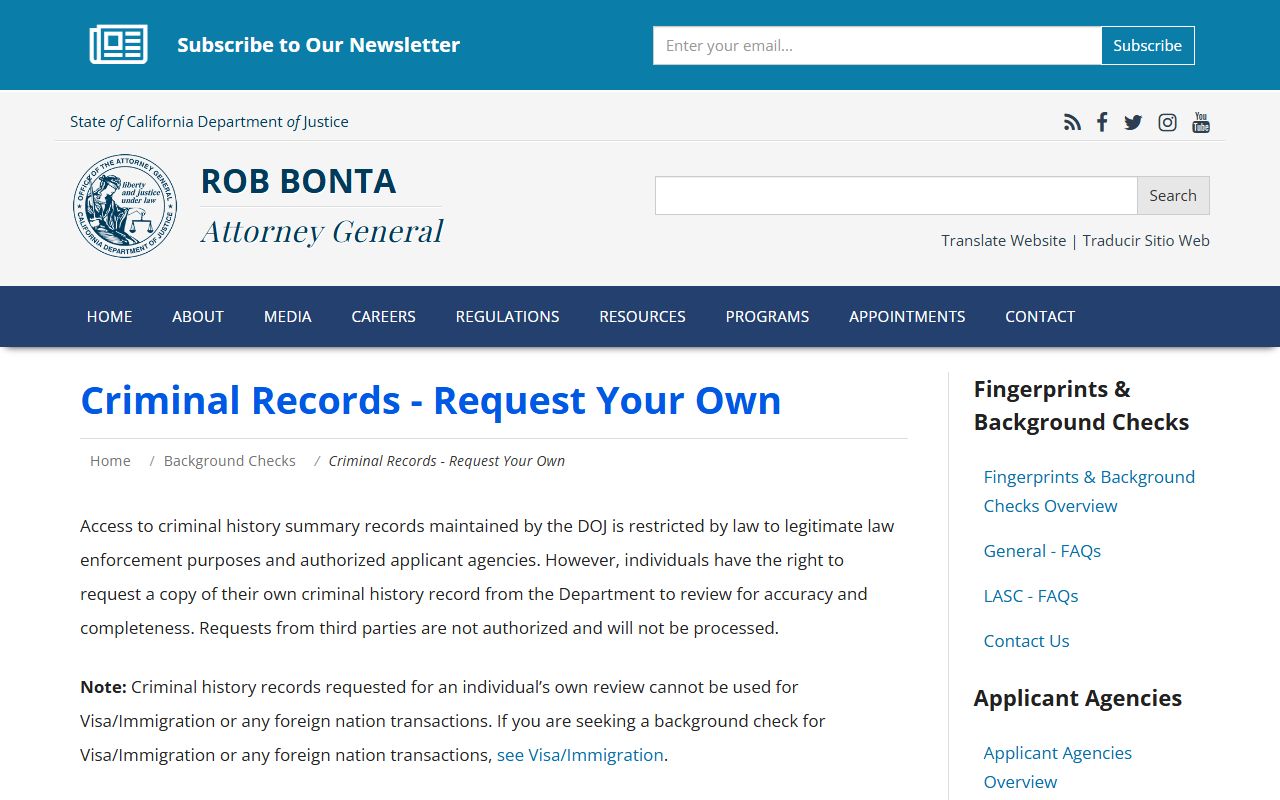 The page lists the live scan steps, the application form, the fee, and the path to challenge an entry that looks wrong.
Public Defender, Clean Slate, and Sealing Process
The Orange County Public Defender's main office is at 801 Civic Center Drive West, Suite 400, Santa Ana, CA 92701. The phone is (657) 251-6090 and the email is PDInfo@ocpubdef.com. The office covers indigent defense at every stage of a state criminal case. It also runs Clean Slate, a free program that helps eligible county residents petition for record-cleaning relief. Clean Slate handles both arrest sealing under Penal Code section 851.91 and conviction dismissal under Penal Code section 1203.4.
The Clean Slate workflow is simple at the top and detailed at every step. A person submits a request, the office screens the case, and an attorney decides which forms fit. The petition goes to the court that handled the case. The District Attorney gets service. Some petitions get a hearing. Some go through on paperwork alone. Filing fees may be waived for low-income petitioners. A grant of relief does not erase the record. It restricts public access or dismisses the conviction for many purposes.
- Contact the Public Defender through the Clean Slate intake page on pubdef.ocgov.com.
- Provide case numbers, charges, and disposition dates if available.
- Wait for the screening to confirm eligibility under section 851.91 or section 1203.4.
- Sign the petition forms and authorize service on the District Attorney.
- Attend the hearing if the court sets one.
- Confirm the database update after the order is signed; updates can lag.
State and Federal Criminal Records
State criminal history in California is held by the Department of Justice. The DOJ runs the state summary criminal history file, sometimes called CORI. Penal Code section 11105 controls who can receive it. Employers and licensing bodies must qualify under that statute or through a separate authorization. Individuals can request a personal record review through live scan. The DOJ page at oag.ca.gov/fingerprints/record-review covers the application, the fee, the review window, and the challenge process for errors.
Federal cases are tracked separately. Federal criminal prosecutions for Orange County run through the U.S. District Court for the Central District of California. Federal records sit on PACER. PACER charges per-page fees unless a waiver applies. Federal custody data is held by the Federal Bureau of Prisons inmate locator. A name on the state portal will not show federal data, and the federal locator will not show county arrests.
For related county data, the Orange County District Attorney's office under District Attorney Todd Spitzer publishes press releases on filed cases and unit-specific work. The DA does not run a public case lookup of its own. Custody status comes from OC Sheriff inmate information. Open warrants on a case appear in the case events on the court portal and may also show on the OCSD warrant tools. See Orange County warrant records for the warrant track and Orange County inmate records for the custody track.
Related Orange County Records
Criminal cases overlap with other record types in the county. A traffic infraction tied to a DUI moves into the criminal calendar. A protective order tied to a domestic violence case touches both criminal and family files. A probation violation calls back to the original sentencing minute order. The right page on this site depends on the question. The list below points to the closest match for the most common follow-up tasks.
- Orange County court records for civil, family, probate, and small claims case search.
- Orange County traffic court records for citations, DUI overlap, and ticket payment.
- Orange County warrant records for bench warrants and outstanding arrest warrants.
- Orange County inmate records for live custody status, booking log, and bail steps.
- Orange County public records for non-court agency records under the CPRA.
- Superior Court for the trial-court structure and justice center list.
Verify any name match with date of birth, case number, or booking number before you act on a search result. The court's portal terms say clearly that online data is not the official record.